

With the daily focus on European crisis and the hope of central bank intervention, one of the essential features of the investment climate – at least for long-term investors – is easy to lose in the shuffle. That feature is valuation. It’s an easy concern to overlook, because with corporate profit margins close to 70% above historical norms (largely because of unsustainably large government deficits coupled with low private savings rates – see Too Little to Lock In), Wall Street is quite happy to look at the ratio of prices to near-term earnings estimates and conclude that valuations are satisfactory. But stocks are not a claim on one year of earnings. They are a claim on a very long stream of cash flows that will actually be delivered into the hands of investors. Unfortunately, the conclusion that stocks are appropriately valued rests on the implicit assumption that profit margins will remain elevated into the indefinite future.
We presently estimate a projected 10-year total (nominal) return for the S&P 500 of less than 4.6% annually. Nothing in recent years, much less the past decade, indicates any material change in the relationship between actual market returns and expected market returns as we estimate them using a range of fundamentals including normalized earnings. Indeed, the 5.1% total return of the S&P 500 over the most recent 10-year period has been right on target (see also my July 7, 2002 comment). It’s notable that even without compelling valuations a decade ago, we lifted 70% of our hedges several months later in early 2003, at what turned out to be the start of the next bull market – something to remember for those who misunderstand our two-data sets issue of 2009-early 2010 and assume that we’ll never lift our hedges until the market is deeply undervalued.
I anticipate that a decade from now, the S&P 500 will have achieved a total return that is very weak from a long-term perspective. Remember also that you don’t “lock in” a 10-year return. You ride it out. I continue to expect that investors will have numerous opportunities to accept risk in the coming years in expectation of much better prospective returns than are presently likely.
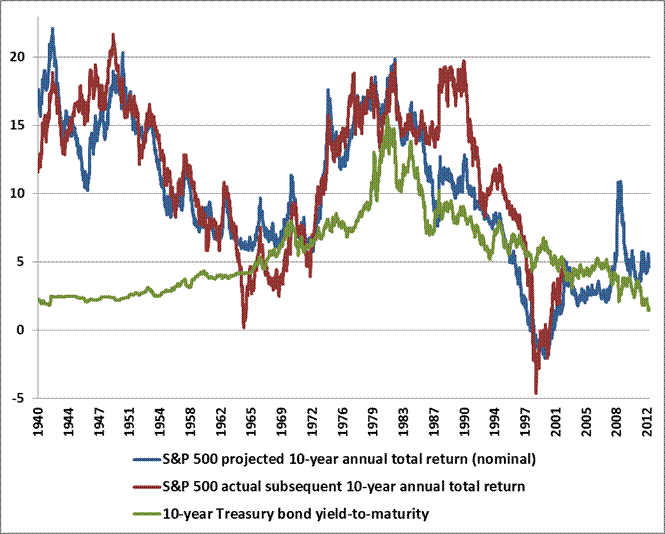
Of course, with the yield on the 10-year Treasury bond at just 1.6%, one might argue that a prospective 10-year return of nearly 4.6% on stocks is still very good by comparison, and should be enough to prevent any substantial adjustment to lower prices and higher prospective returns. To inform that argument, I’ve added the 10-year Treasury bond yield to our standard chart below. Note that the correlation between 10-year S&P 500 returns and 10-year Treasury bond yields (which reflect both expected and actual 10-year returns, provided no default occurs) is just 0.1. There is virtually no relationship at all, with the exception of the early-1980’s, when the prospective and actual returns were quite high for both as a result of inflation shocks.
Read the complete commentary
We presently estimate a projected 10-year total (nominal) return for the S&P 500 of less than 4.6% annually. Nothing in recent years, much less the past decade, indicates any material change in the relationship between actual market returns and expected market returns as we estimate them using a range of fundamentals including normalized earnings. Indeed, the 5.1% total return of the S&P 500 over the most recent 10-year period has been right on target (see also my July 7, 2002 comment). It’s notable that even without compelling valuations a decade ago, we lifted 70% of our hedges several months later in early 2003, at what turned out to be the start of the next bull market – something to remember for those who misunderstand our two-data sets issue of 2009-early 2010 and assume that we’ll never lift our hedges until the market is deeply undervalued.
I anticipate that a decade from now, the S&P 500 will have achieved a total return that is very weak from a long-term perspective. Remember also that you don’t “lock in” a 10-year return. You ride it out. I continue to expect that investors will have numerous opportunities to accept risk in the coming years in expectation of much better prospective returns than are presently likely.
Of course, with the yield on the 10-year Treasury bond at just 1.6%, one might argue that a prospective 10-year return of nearly 4.6% on stocks is still very good by comparison, and should be enough to prevent any substantial adjustment to lower prices and higher prospective returns. To inform that argument, I’ve added the 10-year Treasury bond yield to our standard chart below. Note that the correlation between 10-year S&P 500 returns and 10-year Treasury bond yields (which reflect both expected and actual 10-year returns, provided no default occurs) is just 0.1. There is virtually no relationship at all, with the exception of the early-1980’s, when the prospective and actual returns were quite high for both as a result of inflation shocks.
Read the complete commentary

