


In January, progress on the U.S.-China trade deal seemed to calm the trade war between the two countries. However, everything changed when Covid-19 emerged.
Since the beginning of the pandemic, the demand - and resultant spot price for silver and gold - reached new highs. The stock market fell and rose several times in the hopes and doubts for a vaccine.
Although politics and the gold bullion might not seem to have much in common at first glance, the gold price is inherently tied to political events. After all, it is deemed a safe-haven metal for a reason. So. how do current events affect the price of gold, which is at a nine-year high?
Trade war history
Since the start of Trump’s election campaign, his disdain towards the trading practices between the U.S. and China has remained consistent. The U.S. accused China of unfair trading practices and stealing intellectual property. China saw this as the U.S. trying to use the cultural difference between the concept and treatment of intellectual property to undermine its rise as a global power. Eventually, this escalated into an all-out trade war with both countries imposing tariffs on each other.
These tariffs are supposed to make goods exported from either country more expensive in the other. This will inhibit economic growth for both the U.S. and China as they push people to buy goods made in their home countries, which are "cheaper" only as a result of the tariffs. As a result, the trade war sparked worries for investors in 2019 who feared a recession. Therefore, many sold off their stocks and turned to gold.
Today, the climate between the U.S. and China isn’t much different. Rising tensions between Hong Kong and mainland China have strained the relationship with the U.S. Although Hong Kong has freedom of speech, anti-Communist literature garnered a negative response from the Chinese government. Recently, Beijing posited a new national security law to crack down on anti-government sentiment.
Because of Beijing’s national security law, Trump signed legislation on July 14 to impose sanctions on China. These sanctions also now include Hong Kong, which ends its preferential treatment by the U.S. As a result, China’s foreign ministry declared retaliation in the form of sanctions against the U.S.
Effect on gold price
So how do have these political events influence the gold price?
Back in 2019, they caused investors to sell their stocks and invest in safe-haven precious metals. With the partial trade deal in place in January, investors still continued to buy gold. This is because their worries were left unassuaged from the shaky deal since many tariffs remain in place. The following month, the pandemic gained traction and later expanded into countries beyond China.
However, the new developments in the U.S.-China trade war do not seem to be at the forefront of investors’ minds. The Dow Jones opened about 500 points higher on Wednesday, July 15, a day after this announcement. The S&P 500 futures and Nasdaq 100 futures also opened higher. This was because of positive news regarding Moderna’s potential coronavirus vaccine.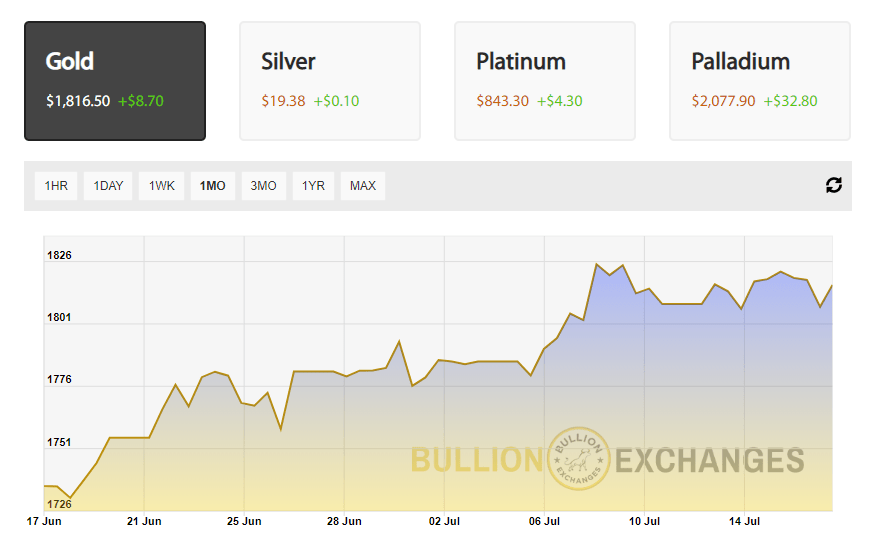
Despite this positive news, the price for physical gold bullion maintains its footing above $1,800 for the current spot and August futures. This shows that there is significant buying strength behind physical gold bullion at this time.
Wall Street analysts believe that this is because the weakening dollar buoys the gold price. As a result, gold and silver remain bullish at this time. Additionally, it’s expected that silver will see September futures hit $20 in the near future.
Russia and the gold price
In other gold-focused political news, Russia released economic news this week regarding money made off their exports. For the first time in modern history, Russia made more money from gold than gas exports between April and May. From April to May, gas exports plummeted to $2.4 billion. This is the lowest price since 2002, and the last time gold exports beat gas for the country was 1994.
To paint a picture of the Russian economy and gold, Russia exported about $5.7 billion worth of gold in 2019 altogether. Between April and May of 2019, Russia exported $247 million worth of gold. However, this year, Russia exported a total of 65.4 tons of gold abroad, worth $3.55 billion in April through May. Mathematically, the comparison between April to May of 2019 and 2020 is a 14 times rise in exports of gold.
This is partly affected by the fact that the Russian Central Bank is not buying gold at this time. Officials also say the opening gold mining season contributed to the rise.
Conclusion
The gold price thus continues to remain bullish from its safe-haven appeal. Economic uncertainty fuels demand. If there is a constrained supply of gold in the future when Russia's foreign output of the metal declines again, the price for the gold bullion will continue to increase.
Read more here:
- How the Economic Recovery Shape Impacts Gold Prices
- Fastenal Company: Why Being Cheap Works as a Business Strategy
Not a Premium Member of GuruFocus? Sign up for a free 7-day trial here.

