

Doximity Inc. DOCS runs a vertical, HIPAA compliant, professional network and workflow platform for U.S. clinicians, with tools for secure messaging, efax, telehealth, and career management. (HIPAA compliance is adhering to U.S. regulations that protect the privacy, security, and integrity of Protected Health Information (PHI).) Its user penetration is very high (with over 80% of U.S. physicians and roughly half of NPs/PAs), giving it a strong network effect and data advantages within the medical professional community. It operates as a Multi-Sided Plaform where the user (i.e. clinicians) are different from the paying customers. The paying customers (which are pharma corporations, Healthcare Systems etc.). pay Doximity for its access to clinicians and for such things as advertising, marketing and other subscription services.
Doximity was founded in 2010 as a physician colloboration platform. COVID-19 acted as a massive accelerant for Doximity, transforming it from a useful networking tool into an essential, daily workflow platform for U.S. clinicians and catalyzing its IPO in 2021 launching it into a long-term growth trajectory.
In its current form, Doximity provides U.S. clinicians with an integrated suite of workflow, communication, AI, knowledge management and career tools through its primary app and web platform. These features aim to streamline daily tasks, reduce administrative burdens, and enhance collaboration in a HIPAA-compliant environment.
Core communication and telehealth offerings include, Doximity Dialer for masked voice calls from personal phones, Dialer Video for easy browser-based patient visits, secure clinician-to-clinician messaging and one-way patient texts, and integrated eFax for sending records or referrals.
AI-driven tools feature Doximity GPT (or DoxGPT), a clinical assistant that drafts prior authorizations, appeals, and patient materials with guideline references, alongside Doximity Scribe, an ambient listener that generates structured notes from in-person or virtual encounters.
Clinical support comes via a personalized newsfeed of medical journals, specialty updates, and drug summaries, while networking tools offer a national clinician directory, professional profiles, and CV management for cross-institution connections.
Career-focused features encompass a job board for clinicians and Talent Finder for employers, plus Hospital Solutions for targeted marketing to promote roles, programs, or telehealth services among Doximity's extensive user base.
Business Model
Doximity operates a freemium model for clinicians, providing core tools like unlimited 1:1 video visits, secure messaging, eFax, Dialer voice calling, clinician directory, newsfeed, Doximity GPT for document drafting, and Doximity Scribe for AI notes entirely free to verified medical professionals such as MDs, DOs, NPs, PAs, pharmacists, and students. A paid Dialer Pro upgrade costs $24 per user per month (billed annually) for individuals or small practices, unlocking unlimited call minutes, group video visits, and reduced restrictions for higher-volume telehealth use. Enterprise solutions like Hospital and Talent tools carry custom pricing for health systems (often starting around $12k per provider annually or $50-100 monthly for large groups), while qualifying nonprofit clinics access Pro-like features at no cost with annual renewal; overall revenue derives mainly from enterprise and pharma clients rather than clinician fees, fueling the free user flywheel.
The company monetizes its platform by selling Business to Business (B2B) services:
- Pharma and healthcare advertising (largest segment): Digital marketing campaigns, including targeted ads, awareness programs, and promotional content delivered to its 80%+ penetration of U.S. physicians and NPs/PAs. This includes performance-based pricing tied to reach and engagement metrics.
- Workflow subscriptions: Recurring fees for premium tools like Doximity Dialer (secure telehealth calling), AI Scribe, DoxGPT, e-faxing, and scheduling, used in daily clinical practice.
- Talent and hiring solutions: Recruitment marketplace connecting health systems with clinicians, monetized via job postings, staffing services, and enterprise contracts.
Overall, Doximity has transformed from an ad-driven platform into a subscription-first SaaS business with diversified clinical workflows, while still monetizing its unique clinician network primarily through pharma and health-system subscriptions.
Over the last 5 years, Doximity's revenue mix has shifted dramatically from a pharma advertising–heavy model to one dominated by subscription revenue (now ~95% of total), reflecting a successful transition to predictable, recurring revenue with higher quality growth.
Evolution of Revenue Mix
| Fiscal Year | Total Revenue ($M) | Subscription Revenue ($M) | Subscription % of Revenue | YoY Subscription Growth | Notes on Mix Shift |
| 2021 | ~207 | ~160 (est.) | ~77% | ~50% | Early pivot from pure ad model post-IPO |
| 2022 | ~344 | ~260 (est.) | ~76% | ~62% | Dialer and staffing products gaining traction |
| 2023 | ~419 | ~350 (est.) | ~83% | ~35% | Integration of AI and telehealth tools |
| 2024 | 475 | 450 | ~95% | ~29% | Subscription dominance solidified |
| 2025 | 570 | 543.8 | 95.3% | 21% | Nearly all revenue now subscription-based |
Unit Economics
Doximity does not publicly disclose per-user revenue or per-clinician monetization metrics (such as revenue per physician or ARPU) in its earnings releases or investor presentations. Instead, it reports aggregate company-level financials and customer-count aggregates tied to its B2B/corporate buyers—pharma brands and health systems—rather than individual clinicians.
The company shares total revenue figures, subscription revenue and growth rates, net revenue retention (e.g., 119% in Q4 FY25), the number of customers generating at least $500K in revenue (116 in FY25), total network size (~2M professionals with ~80% physicians), and high-level engagement stats (~620K active clinicians). It does not break out revenue per clinician, average subscription length per user, or clinician-level churn beyond broad active-user counts. This approach reflects Doximity's monetization model, which relies on enterprise subscriptions sold to pharma and health systems rather than direct payments from clinicians, making per-customer (pharma brand or health system) revenue and retention the more relevant unit economics. However, per-clinician economics can only be derived as rough estimates: approximately $285 per clinician annually (total revenue divided by 2M) or about $920 per active clinician annually ($570M divided by 620K active users), but these are not officially reported metrics.
Competitive advantages
The main qualitative strengths are:
- Vertical network effects: penetration among clinicians is significantly higher than horizontal networks like LinkedIn in this specific domain, which reinforces its value for targeted medical marketing and recruiting.
- Embedded workflow: tools such as secure messaging, telehealth, and faxing sit in daily clinical workflows, making the platform more “utilitylike” and harder to rip out than a pure social network.
- Data and targeting: detailed specialty, location, and practice profiles enable highly targeted marketing campaigns for pharma and health systems that are difficult to replicate at scale outside a clinicianonly network.
- Financial profile: recent analyses highlight robust revenue growth and solid profitability, suggesting a capitallight, highmargin software/marketplace model rather than a heavy services business.
Economic Moat
Taken together, this looks like a defensible, narrow moat within a specialized healthcare IT niche, though not immune to platform competition or shifts in digital marketing channels. Doximity's economic moat stems primarily from network effects within a highly specialized, verified clinician community, reinforced by switching costs, data advantages, and regulatory/compliance barriers that together create a durable moat in the U.S. healthcare software niche.
Key risks and weaknesses
Several qualitative issues temper the story:
- Customer and revenue concentration: pharma advertising remains a major revenue driver, so budget cycles, regulatory shifts on drug promotion, or internal ROI debates at large pharma can create volatility.
- Legal and governance overhang: shareholder suits allege materially false statements around active physician users and engagement, and a securities class action has survived a motion to dismiss, raising questions about disclosure quality and management credibility.
- Platform metric sensitivity: because the value proposition depends on high engagement and accurate reach metrics, any perceived inflation or deterioration in these numbers directly undermines the business narrative.
- Competitive pressure: while Doximity dominates its niche, it faces encroachment from generic platforms (e.g., LinkedIn for recruiting and professional presence) and other telehealth and communication vendors.
- These factors shift some of the risk from pure business model risk to governance, disclosure, and customer mix risk.
The main vulnerability is not moat erosion per se, but customer concentration (top 20 pharma/health-system clients drive ~84% of revenue). Loss of even a few customers can cause substantial disruption.
Industry and competitive landscape
Doximity makes its place at the intersection of healthcare IT, telehealth, and digital marketing, competing indirectly with large tech and more directly with telemedicine and virtual care vendors. Market share data in broader "communications/telehealth” buckets show Doximity as a small revenue player compared to giants like Microsoft and Zoom, but with a highly specialized healthcare footprint rather than a general purpose platform.
Within healthcare specific solutions, it competes with telehealth companies like Teladoc, Amwell, and a long tail of niche vendors, as well as with data/engagement tools used by pharma commercial teams. The rapid evolution of AI-driven tools for clinician productivity and marketing analytics adds both an opportunity (better targeting, more automation) and a threat (of disintermediation, if others weaponize AI and data more effectively.)
Doximity Positioning with selected peers
| Company | Core focus | Doximity's relative position |
| Doximity | Clinician network & workflow | Deep healthcare vertical focus, high clinician penetration, adheavy mix. |
| Microsoft / Linkedin | General networking/ productivity/communications | Massive scale; Doximity defends via niche, compliance, and physician focus. |
| Zoom | Generic video/telehealth platform | Doximity differentiates via integrated clinician network, knowledge management and workflow tools. |
| Teladoc / Amwell | Virtual care delivery | These own patient-to-provider encounters; Doximity is more B2B tools and marketing. |
Growth drivers and outlook
Deeper penetration of health system marketing and staffing budgets (more accounts, bigger campaigns, cross-selling hiring tools and workflow products).
Expansion of telehealth and clinician productivity solutions, where the existing network gives low customer acquisition costs and a natural base for new modules.
Leveraging AI and data to improve campaign performance, recommendations, and workflow automation, which can both enhance the moat and justify premium pricing.
Growth
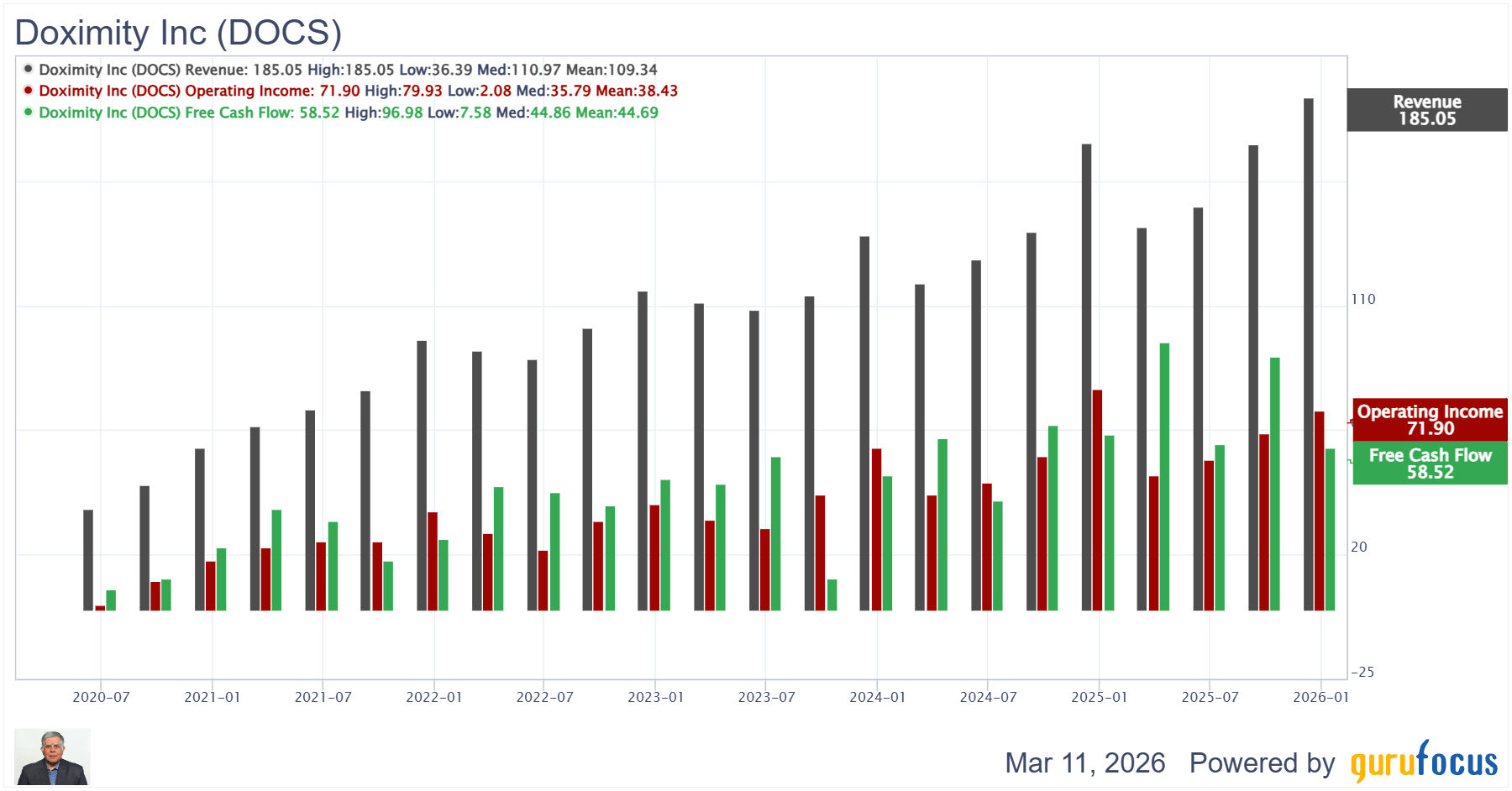
Doximity has sustained strong but maturing growth since its June 2021 IPO, expanding revenue from $207M (FY2021) to $570M (FY2025) and ~$642M TTM (FY2026 est.), with cumulative ~210% revenue growth amid a shift to profitability and capital returns.
Revenue growth decelerated from triple digits (78% FY21, 66% FY22) to double digits (13-22% FY23-FY26), reflecting U.S. market saturation but steady execution. Net margins expanded to 33-37% (e.g., Q3 FY26: $62M net on $185M revenue), with Adjusted EBITDA margins ~60%. FCF grew robustly (e.g., FY25: $267M, +50% YoY), enabling $500M+ buybacks.
| Growth Rates (Per Share) | CAGR - 5-Year | 1-Year |
| Revenue | 30.40% | 15.80% |
| EPS without NRI | 50.50% | 45.00% |
| EBIT | 49.10% | 7.00% |
| EBITDA | 49.10% | 7.90% |
| Free Cash Flow | 49.10% | 32.20% |
Balance Sheet
Doximity maintains a pristine, conservative balance sheet typical of a high-margin SaaS platform business, featuring substantial cash and short-term investments, negligible debt, and robust free cash flow generation that comfortably funds operations, share repurchases, and opportunistic M&A without solvency risks. The asset-light model emphasizes high-quality receivables from pharma and health-system clients alongside modest intangibles, while liabilities are limited to routine working-capital items like deferred revenue. Consistent profitability (mid-30s% net margins) steadily builds equity through retained earnings, positioning the company to weather business cyclicality or legal overhangs, though customer concentration remains the primary vulnerability rather than any financial fragility.
Valuation
Doximity trades at an attractive valuation for its quality & growth, with a ~$4.7B market cap (mid-March 2026) implying ~7.4x EV/revenue and ~19-21x P/E on ~$640M TTM revenue and $239M net income—reasonable given 89% gross margins, 38% net margins, 110%+ net retention, and robust FCF (~$270M FY25).
Key Valuation Metrics
| Metric | Value | Context |
|---|---|---|
| P/S | 7.4x TTM | 8-12x (SaaS peers); ~13% FY26 growth |
| P/E | 19.7x (16x Fwd) | Cheap vs. 30%+ historical EPS CAGR |
| EV/FCF | 15-18x (Est.) | $500M+ buyback capacity; zero net debt |
| PEG | <1.0 | Undervalued vs. 4-11% EPS growth |
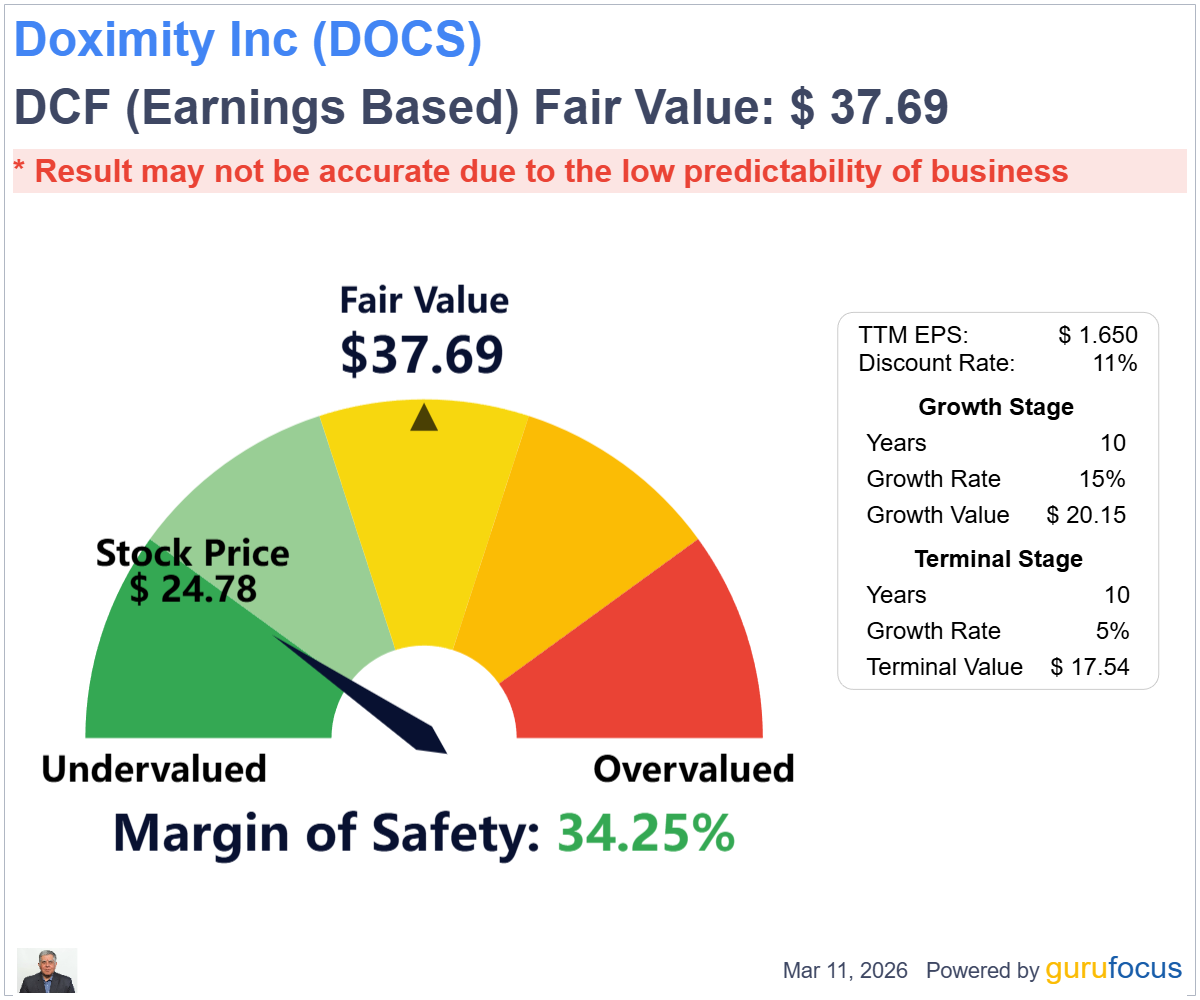
Gurufocus two stage DCF Model using reasonable Earnings per share growth assumptions indicate a good margin of safety.
Conclusion
In summary, Doximity stands out as a high-quality, capital-light SaaS platform with a defensible niche in clinician workflows, boasting 80%+ U.S. physician penetration, robust 33-37% net margins, and $267M FY25 FCF on $642M TTM revenue. Trading at an attractive 7.4x EV/Revenue and 19x P/E, it offers a compelling risk-reward profile for value investors, tempered by pharma concentration and some legal overhangs—positioning it as a narrow-moat opportunity in healthcare IT.

