

On July 30, 2026, Tempus AI Inc (NASDAQ: TEM) updated its financial guidance for fiscal year 2026, projecting an adjusted EBITDA of approximately $65 million. This forecast notably excludes any impact from the anticipated Personalis acquisition, expected to close in late Q4 2026 or early 2027.
- Tempus AI’s current Price-to-Sales (P/S) ratio of 5.72 is below its historical median of 7.82, indicating the market prices in tempered growth expectations despite the company’s unprofitability, rendering earnings-based valuation metrics like P/E inapplicable.
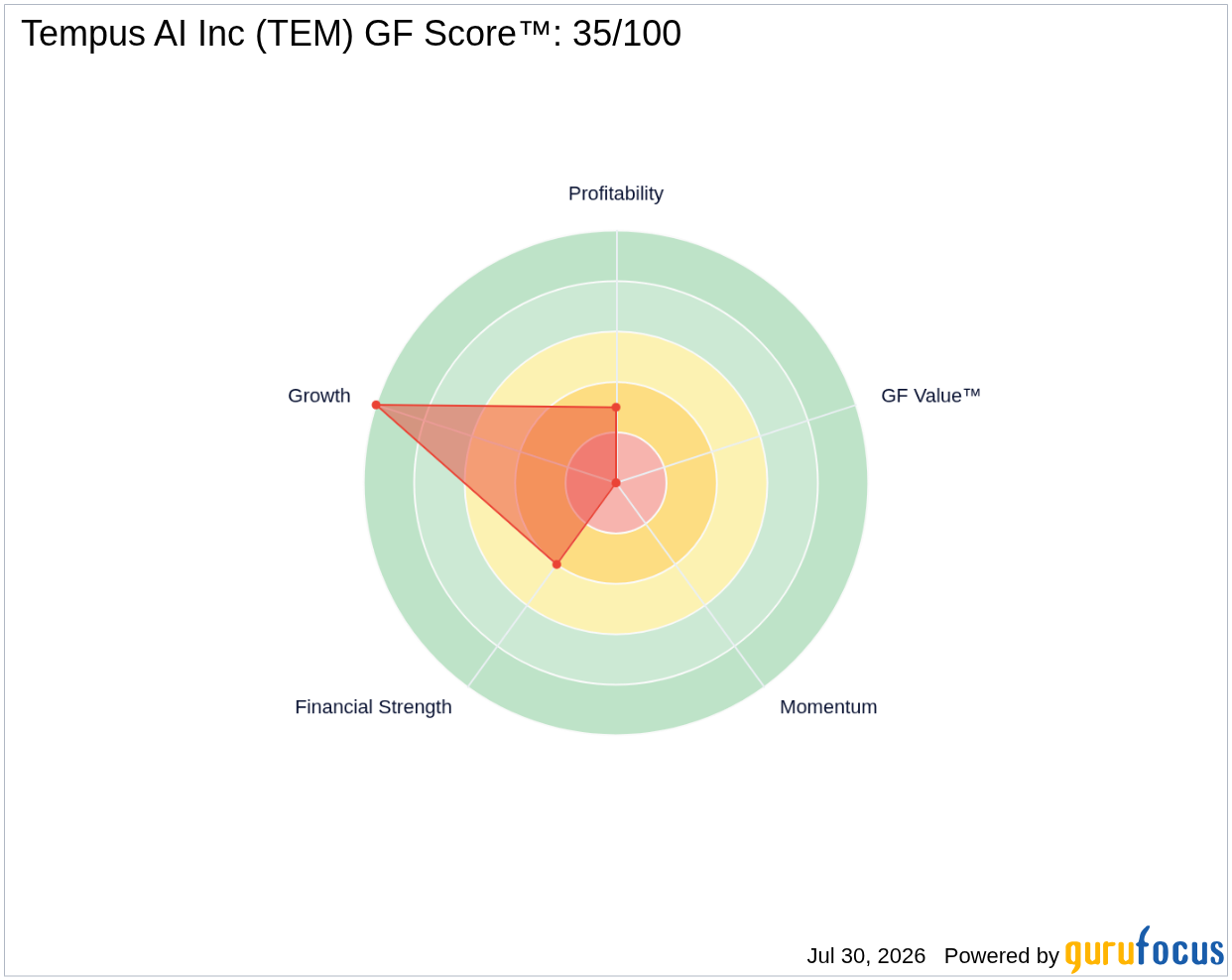
- The company’s GF Score™ stands at 35/100, reflecting moderate financial health with strong growth offset by weak profitability and valuation metrics.
- Insider activity signals caution, with no insider buying and $23.3 million in insider sales over the past three months, while guru ownership remains mixed, with 7 gurus holding TEM but trimming slightly more than adding recently.
What's Behind the News?
Tempus AI’s revised EBITDA outlook signals cautious optimism about near-term operational performance, projecting adjusted EBITDA of roughly $65 million for fiscal 2026. Management’s explicit assumption that the pending Personalis deal will not materially affect 2026 financials suggests a focus on organic growth and operational efficiency ahead of the acquisition’s completion. This update provides investors with a clearer picture of the company’s standalone profitability trajectory amid ongoing strategic initiatives.
Tempus AI Inc operates in the healthcare sector, specifically within Healthcare Providers & Services. The company leverages advanced AI technologies, including generative AI, to enhance laboratory diagnostics through its proprietary Tempus Platform, which integrates and unlocks siloed healthcare data. With a market capitalization of $7.97 billion, Tempus AI is positioned as a speculative growth stock in a rapidly evolving healthcare technology landscape.
Is TEM Overvalued on a Price-to-Sales Basis?
Tempus AI’s current Price-to-Sales (P/S) ratio stands at 5.72, which is below its historical median P/S of approximately 7.82 over the past two years. This compression suggests that the market is pricing in slower future revenue growth or increased risk, despite the company’s 13% revenue growth over the past three years. Given that Tempus AI remains unprofitable with a negative EBITDA margin (-9.3%) and negative earnings per share (-1.73), traditional earnings-based valuation metrics like the P/E ratio are not meaningful for assessing its valuation. Investors instead rely on sales multiples and growth prospects to gauge value.
While the GF Value™ metric for TEM is not available for precise valuation due to the company’s unprofitability and cash flow negativity, it serves as a directional caution. Investors should interpret the current P/S multiple in the context of the company’s speculative growth profile and ongoing losses. For more on GF Value™, see GF Value™.
What Does TEM's GF Score™ Tell Us?
The GF Score™ aggregates multiple dimensions of a company’s financial health, including profitability, growth, financial strength, valuation, and momentum, to provide a holistic snapshot of investment quality. Tempus AI’s GF Score™ of 35/100 indicates moderate overall quality, driven primarily by its strong growth but hampered by weak profitability and financial strength metrics.
| Metric | Rating (out of 10) |
|---|---|
| GF Score™ | 35/100 |
| Financial Strength | 4/10 |
| Profitability | 3/10 |
| Growth | 10/10 |
Tempus AI’s standout strength lies in its growth rank, which scores a perfect 10/10, reflecting robust revenue and EBITDA growth rates over recent years (13% revenue growth and 43.3% EBITDA growth over three years). However, profitability remains a significant challenge, with negative operating and net margins dragging down the overall score. Financial strength is moderate, but the company’s Altman Z-Score of 1.65 places it in the distress zone, signaling potential bankruptcy risk within two years if conditions do not improve. Investors should weigh these contrasting signals carefully. For further details, visit the TEM stock page.
What Are Gurus and Insiders Doing with TEM?
GuruFocus tracks 7 premium gurus holding shares of Tempus AI. In recent quarters, 4 gurus have added to their positions while 5 have trimmed, reflecting a cautious but not outright bearish stance among top institutional investors. This nuanced guru activity provides a valuable signal beyond typical retail investor data sources, highlighting a split sentiment among sophisticated market participants.
Insider activity over the past three months shows no insider purchases but significant insider selling totaling $23.3 million. This net selling by insiders may indicate a lack of confidence in near-term prospects or a desire to realize gains amid valuation uncertainties. Such insider behavior is a critical consideration for investors evaluating management’s alignment with shareholder interests.
What This Means for Investors
Tempus AI’s revised EBITDA outlook and current valuation metrics underscore the challenges faced by an unprofitable, cash-flow-negative growth company navigating a competitive healthcare technology market. The below-historical median P/S ratio suggests tempered market expectations for future growth, while the absence of meaningful earnings precludes reliance on P/E valuation. Mixed signals from guru ownership and notable insider selling add complexity to the investment thesis. Ultimately, investors should approach TEM as a speculative growth opportunity with significant execution risks and monitor operational progress closely. For ongoing updates and comprehensive data, visit the TEM stock page or explore opportunities through the GuruFocus Stock Screener.
Frequently Asked Questions
What is TEM's GF Score™?
Tempus AI’s GF Score™ is 35 out of 100, indicating moderate overall quality with strong growth offset by weak profitability and financial strength.
Is TEM overvalued or undervalued?
Based on its Price-to-Sales ratio of 5.72, which is below its historical median of 7.82, TEM appears to be valued conservatively relative to its past. However, as an unprofitable company, earnings-based valuation metrics like P/E are not meaningful.
What is TEM's P/E ratio compared to historical?
Tempus AI does not have a meaningful P/E ratio due to ongoing losses. Instead, its financial strength metrics, such as an Altman Z-Score of 1.65 indicating distress risk, provide insight into its financial health.
This stock alert was generated using automated technology and GuruFocus financial data to provide readers with timely and accurate market reporting. This content was reviewed by GuruFocus editorial team prior to publication. Please send any questions or comments about this story to [email protected].

