

On July 31, 2026, Space Exploration Technologies Corp SPCX is seeing a notable surge in short interest ahead of its Q2 earnings report and the expiration of its initial post-IPO lockup period.
- SpaceX trades at a Price-to-Sales (P/S) ratio of 57.98, below its historical median of 77.1x but still extremely elevated versus typical industry standards; earnings-based valuation metrics like P/E are not applicable due to ongoing losses.
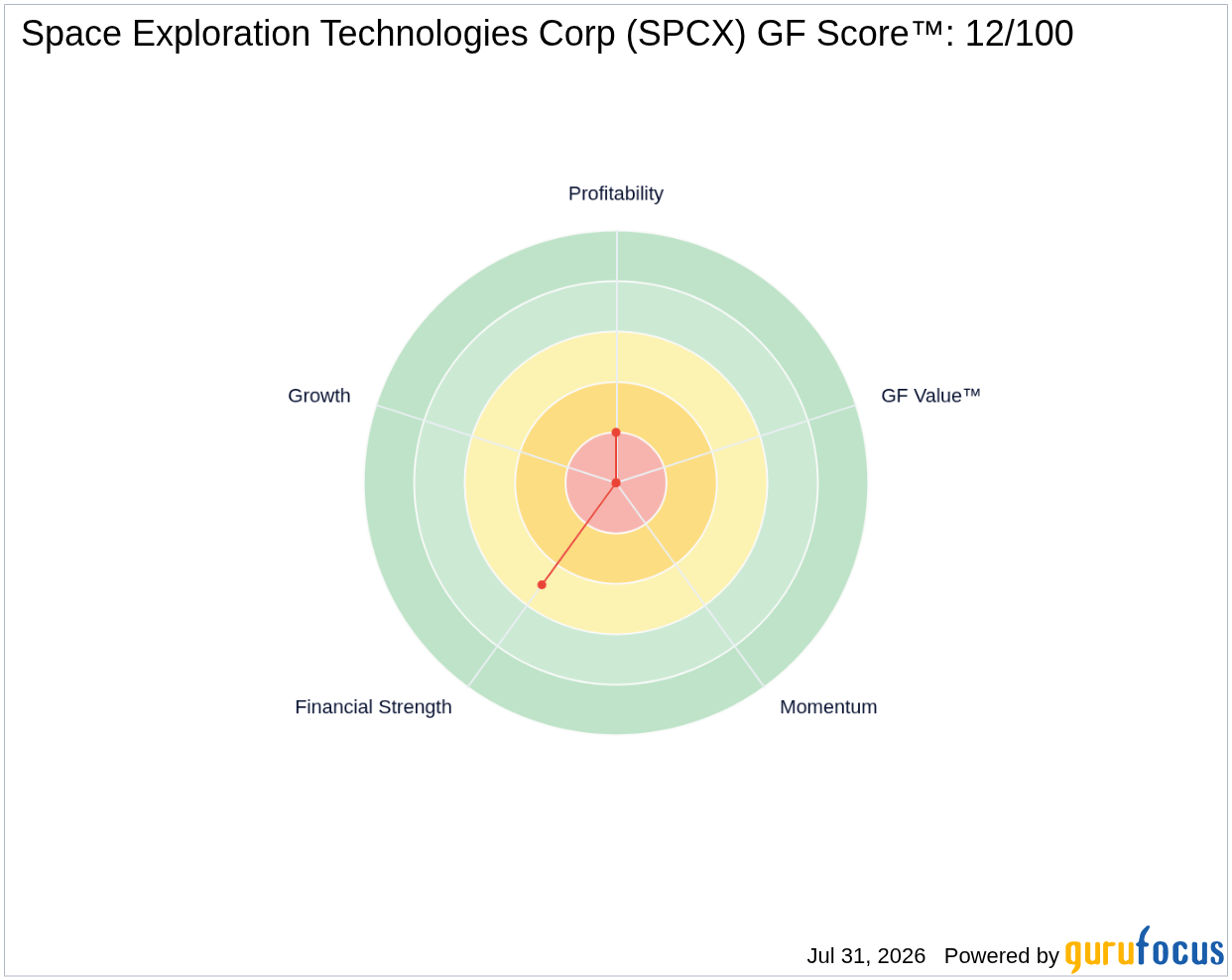
- The company's GF Score™ stands at a low 12/100, signaling significant challenges in profitability and growth despite moderate financial strength.
- Insider activity shows no recent purchases and limited selling, while financial strength is middling at 5/10, reflecting a balanced but cautious capital structure.
What's Behind the News?
SpaceX is currently under pressure as short sellers have amassed approximately $24.2 billion in notional short positions, representing 32.2% of the company’s float. This heightened short interest coincides with two critical upcoming events: the company’s Q2 earnings announcement scheduled for August 4, 2026, and the expiration of its first post-IPO lockup, which will release about 91.5 million shares into the market. Since peaking at $201.8 on June 16, SpaceX’s share price has declined sharply by 44% to roughly $112.2, reflecting growing investor skepticism. Additionally, borrowing costs for shorting the stock have surged from 0.51% to 2.13% over the past five weeks, underscoring the contentious market sentiment.
Founded in 2002, Space Exploration Technologies Corp operates in the Industrials sector, specifically within the Aerospace & Defense industry. The company designs, manufactures, and operates reusable rockets and has expanded into satellite communications through its Starlink constellation. In early 2026, SpaceX acquired xAI, a firm specializing in large language models and AI infrastructure, further diversifying its technology portfolio. With a market capitalization of $1.48 trillion, SpaceX is a dominant player in its field but continues to face profitability and cash flow challenges.
Is SPCX Overvalued on a Price-to-Sales Basis?
SpaceX’s current P/S ratio stands at 57.98, which is substantially lower than its historical median of approximately 77.1x but remains extraordinarily high by conventional standards. This elevated P/S multiple suggests that the market is pricing in significant future revenue growth and potential profitability improvements, despite the company’s current unprofitable status. Given SpaceX’s negative earnings per share (-$0.51 TTM) and negative operating margin (-11.05%), traditional earnings-based valuation metrics such as the P/E ratio are not meaningful for assessing its value. Investors must therefore rely on sales-based and other forward-looking metrics to gauge the company’s prospects.
While the GF Value™ metric cannot provide a precise fair value estimate for SpaceX due to its loss-making status and negative free cash flow, it serves as a directional warning. The absence of a reliable GF Value™ reading highlights the difficulty in applying standard valuation models to a company still investing heavily in growth and innovation. For more on GF Value™, visit GF Value™.
What Does SPCX's GF Score™ Tell Us?
The GF Score™ is a composite measure that evaluates a company’s overall financial health, profitability, growth, valuation, and momentum to provide a holistic view of its investment quality. SpaceX’s GF Score™ of 12 out of 100 indicates significant weaknesses, particularly in profitability and growth, despite moderate financial strength.
| Metric | Rating |
|---|---|
| GF Score™ | 12/100 |
| Financial Strength | 5/10 |
| Profitability | 2/10 |
SpaceX’s strongest area is its financial strength, rated at 5 out of 10, reflecting a manageable debt-to-equity ratio of 0.56 and solid liquidity ratios (current ratio of 1.45 and quick ratio of 1.33). However, profitability remains a critical weakness, with negative operating and net margins (-11.05% and -26.44%, respectively), and a return on equity of -14.71%. Growth metrics are stagnant or negative, and momentum indicators are not favorable. This mixed profile suggests that while SpaceX has the financial foundation to support ongoing investments, it faces significant hurdles in translating those investments into profits. For further details, visit the SPCX stock page.
What Are Gurus and Insiders Doing with SPCX?
Currently, there is no reported premium guru ownership or trading activity for SpaceX, which means no notable institutional guru investors have publicly added or trimmed their positions recently. Insider activity is minimal, with no insider purchases reported in the past three or twelve months and only one insider sale in the last year valued at approximately $1.2 million. This lack of significant insider buying or selling may reflect cautious sentiment amid the company’s ongoing transition and market volatility.
What This Means for Investors
SpaceX’s valuation on a price-to-sales basis remains highly elevated despite the recent share price decline, signaling that investors continue to price in substantial future growth and technological innovation. However, the company’s persistent unprofitability and negative free cash flow, combined with a low GF Score™, underscore the risks inherent in its current financial profile. The surge in short interest and the approaching lockup expiration add further uncertainty in the near term. Investors should weigh these factors carefully, recognizing that traditional earnings metrics do not apply and that valuation depends heavily on execution and future revenue growth. For a comprehensive overview and ongoing updates, see the SPCX stock page.
Frequently Asked Questions
What is SPCX's GF Score™?
SPCX’s GF Score™ is 12 out of 100, indicating weak overall financial health and profitability but moderate financial strength. This score reflects challenges in turning revenue growth into profits.
Is SPCX overvalued or undervalued?
Based on its Price-to-Sales ratio of 57.98, which is below its historical median but still very high, SPCX appears overvalued relative to typical industry standards. Earnings-based valuation metrics like P/E are not meaningful due to the company’s ongoing losses.
What is SPCX's P/E ratio compared to historical?
SPCX does not have a meaningful P/E ratio because it is currently unprofitable, with negative earnings per share. Instead, financial strength metrics provide better insight into its capital structure and risk profile.
This stock alert was generated using automated technology and GuruFocus financial data to provide readers with timely and accurate market reporting. This content was reviewed by GuruFocus editorial team prior to publication. Please send any questions or comments about this story to [email protected].

