


On August 13, 2026, Oracle Corp (NYSE: ORCL) announced a major expansion of its collaboration with Amazon Web Services, launching the Oracle AI Database@AWS across 22 global regions. This initiative introduces pay-per-use pricing for Exadata performance, aiming to meet growing enterprise demand for cost-efficient modernization of Oracle workloads within AWS.
- Oracle's current Price-to-Sales (P/S) ratio of 6.63x significantly exceeds its historical median of 5.4x and industry averages, signaling that the market prices in robust future growth despite the company’s unprofitable and cash-flow-negative status, rendering earnings-based valuation metrics like P/E less relevant.
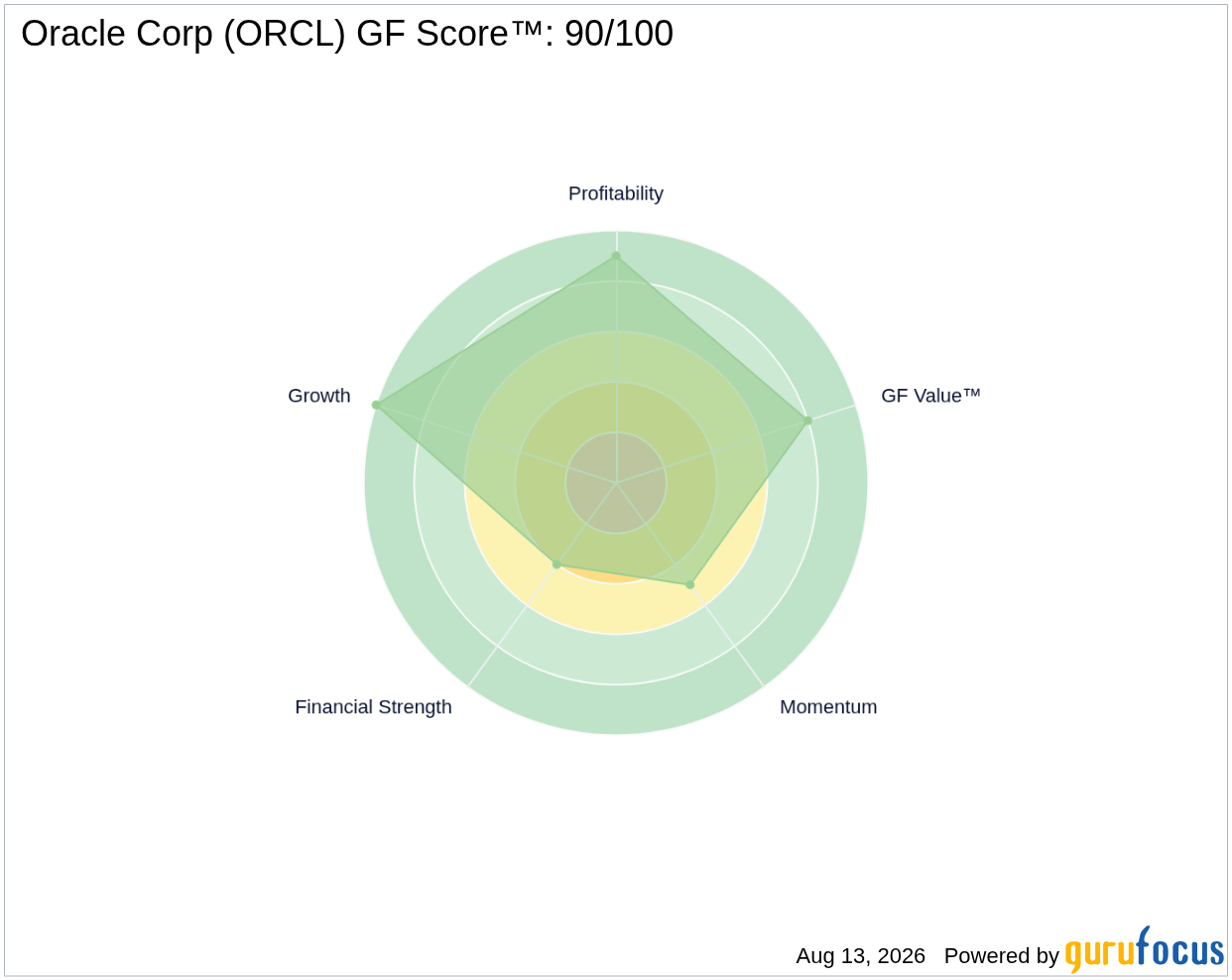
- ORCL boasts a strong GF Score™ of 90/100, reflecting solid profitability and growth metrics despite some financial strength concerns.
- Insider activity shows no insider buying and $63.7 million in insider selling over the past three months, while 21 premium gurus hold ORCL shares, with 14 adding and 11 trimming recently, highlighting mixed but active institutional interest.
What's Behind the News?
Oracle’s announcement to broaden its Oracle AI Database@AWS offering into 22 regions worldwide marks a significant step in its cloud strategy, emphasizing flexibility and cost efficiency through pay-per-use pricing for Exadata performance. This move aligns with increasing enterprise demand for scalable, cloud-native database solutions that integrate advanced AI capabilities. Notable clients such as CJ Olive Young and Kobalt Music Group exemplify early adoption, underscoring Oracle’s appeal in diverse sectors.
Oracle Corp, a technology giant with a Market Cap of $441.52 billion, operates primarily in the software industry, providing enterprise applications, middleware, and cloud infrastructure. Founded in 1977, Oracle pioneered commercial SQL-based relational databases and continues to evolve its offerings to support modern workloads, including large language model training and inferencing. The company’s broad IT deployment models—on-premises, cloud, and hybrid—position it as a key player in enterprise digital transformation.
Is ORCL Overvalued on a Price-to-Sales Basis?
Oracle’s current Price-to-Sales ratio stands at 6.63x, which is notably higher than its five-year median P/S of approximately 5.4x. This premium valuation suggests that investors are pricing in significant future revenue growth and strategic success, particularly in cloud and AI-enabled database services. However, Oracle’s unprofitable and cash-flow-negative status complicates traditional earnings-based valuation methods. The company’s negative free cash flow margin (-35.16%) and negative free cash flow per share (-$8.12) indicate that relying on P/E ratios is misleading in assessing intrinsic value at this stage.
GuruFocus’ proprietary GF Value™ metric estimates Oracle’s intrinsic value at $190.53 per share, implying the stock is modestly undervalued by about 19.6% relative to the current price of $153.28. While this suggests some margin of safety, GF Value™ should be interpreted cautiously here as it relies on historical multiples and growth assumptions that may not fully capture Oracle’s current cash flow challenges and evolving business model. For more on GF Value™, see GF Value™.
What Does ORCL's GF Score™ Tell Us?
The GF Score™ aggregates multiple dimensions of a company’s financial health, profitability, growth, valuation, and momentum into a single comprehensive rating. Oracle’s GF Score™ of 90/100 indicates a strong overall profile, driven primarily by exceptional profitability and growth metrics, despite some weaknesses in financial strength and momentum.
| Metric | Rating |
|---|---|
| GF Score™ | 90/100 |
| Financial Strength | 4/10 |
| Profitability | 9/10 |
| Growth | 10/10 |
| Valuation | 8/10 |
| Momentum | 5/10 |
Oracle’s strongest areas are growth and profitability, reflecting solid revenue growth over the past three years (8.6%) and strong operating margins (33.32%) relative to peers. However, financial strength is a relative weakness, with a modest current ratio of 1.12 and a concerning Altman Z-Score of 1.77, which signals potential financial distress risk. Momentum is moderate, reflecting mixed recent price performance. For further details, visit the ORCL stock page.
What Are Gurus and Insiders Doing with ORCL?
Oracle’s stock is held by 21 premium gurus tracked by GuruFocus, with 14 increasing their positions and 11 reducing stakes in recent quarters. This relatively balanced but active institutional ownership indicates cautious optimism among top investors, who are likely weighing Oracle’s growth prospects against its financial challenges. Insider activity over the past three months shows no insider purchases but $63.7 million in insider selling, suggesting some executives or insiders are taking profits or reallocating capital. This insider selling, combined with mixed guru activity, provides a nuanced signal for investors to consider.
What This Means for Investors
Oracle’s valuation narrative is dominated by its elevated Price-to-Sales ratio, which implies the market expects strong future revenue growth despite current unprofitability and negative cash flow. Earnings-based metrics like P/E are not meaningful here, so investors should focus on growth execution and improving cash flow dynamics. The GF Value™ suggests modest undervaluation, but this should be treated as a directional indicator rather than a precise target due to Oracle’s complex financial profile. Meanwhile, the mixed signals from guru ownership and insider selling underscore the importance of monitoring institutional sentiment and insider behavior as part of a comprehensive investment analysis. For a deeper dive into Oracle’s fundamentals and market positioning, visit the ORCL stock page or explore opportunities using the GuruFocus Stock Screener.
Frequently Asked Questions
What is ORCL's GF Score™?
ORCL’s GF Score™ of 90/100 reflects strong profitability and growth, balanced by moderate financial strength and momentum. This composite score helps investors quickly assess the company’s overall financial health and performance.
Is ORCL overvalued or undervalued?
Based on Price-to-Sales, ORCL trades above its historical median, implying expectations of future growth. However, earnings-based valuation metrics like P/E are not meaningful due to the company’s unprofitable and cash-flow-negative status. The GF Value™ indicates the stock is modestly undervalued by about 19.6%, serving as a directional signal.
What is ORCL's P/E ratio compared to historical?
Oracle’s trailing P/E ratio is 26.29x, below its five-year median of 32.3x, but given the company’s negative free cash flow and financial complexities, P/E is not a reliable valuation measure in this case.
This stock alert was generated using automated technology and GuruFocus financial data to provide readers with timely and accurate market reporting. This content was reviewed by GuruFocus editorial team prior to publication. Please send any questions or comments about this story to [email protected].

