


Cisco Systems CSCO, the networking and cybersecurity giant, tumbled roughly 8.8% in Thursday's regular session even after putting up record quarterly numbers and forecasting a stronger-than-expected year ahead. That tells you exactly where Wall Street's attention is: not the revenue beat, but the price Cisco is paying to chase the AI infrastructure boom. The company is selling a lot more networking gear. The problem is that those extra sales are arriving with thinner margins.
The growth numbers were hard to ignore. Cisco's fiscal fourth-quarter results showed revenue surging 18% to $17.3 billion, while adjusted earnings climbed 23% to $1.22 per share. Networking revenue jumped 28%, and product orders shot up 35%. AI demand was the headline act: hyperscaler AI-infrastructure orders hit $4 billion in the quarter and $9.3 billion for the full year. Cisco now sees roughly $7.5 billion of revenue from that business in fiscal 2027. AI demand is clearly real. Cisco is clearly winning orders. Now comes the harder part: turning that flood of demand into equally impressive profits.
That is where the market slammed on the brakes. Adjusted gross margin fell 210 basis points to 66.3%, and Cisco's first-quarter outlook of 65%–66% suggests the squeeze is not disappearing anytime soon. Even with fiscal 2027 revenue projected at $72.2 billion to $73.4 billion, comfortably above the $68.69 billion analyst consensus cited by Reuters, investors are refusing to give Cisco a free pass.
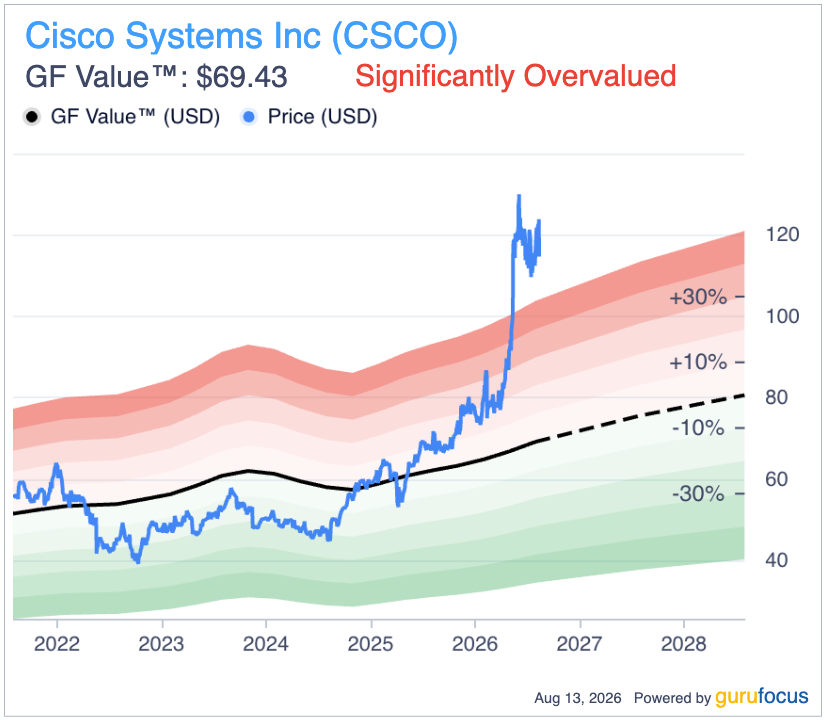
The valuation picture makes that skepticism even sharper. The chart shows Cisco at $114.69 versus a GF Value™ estimate of just $69.43, leaving the stock 65.19% above GF Value™. That is a hefty premium for a company entering an AI-driven growth cycle with margins moving the wrong way. Cisco has already proved it can capture the orders. The next test is tougher: prove the AI boom can expand profits fast enough to justify the price investors are being asked to pay.

