


On August 14, 2026, Goldman Sachs (NYSE: GS) is actively engaging potential investors for Nvidia’s ambitious $500 billion AI infrastructure financing initiative. This strategic move positions Goldman Sachs at the center of a groundbreaking capital raise targeting U.S. insurers, banks, and asset managers, with Goldman providing junior capital and private-credit financing solutions.
- Goldman Sachs’s Price-to-Sales (P/S) ratio currently stands at 4.87x, nearly double its historical median of 2.61x, signaling market expectations of significant future growth; traditional earnings-based valuation metrics like P/E are less relevant due to GS’s unprofitable and cash-flow-negative status.
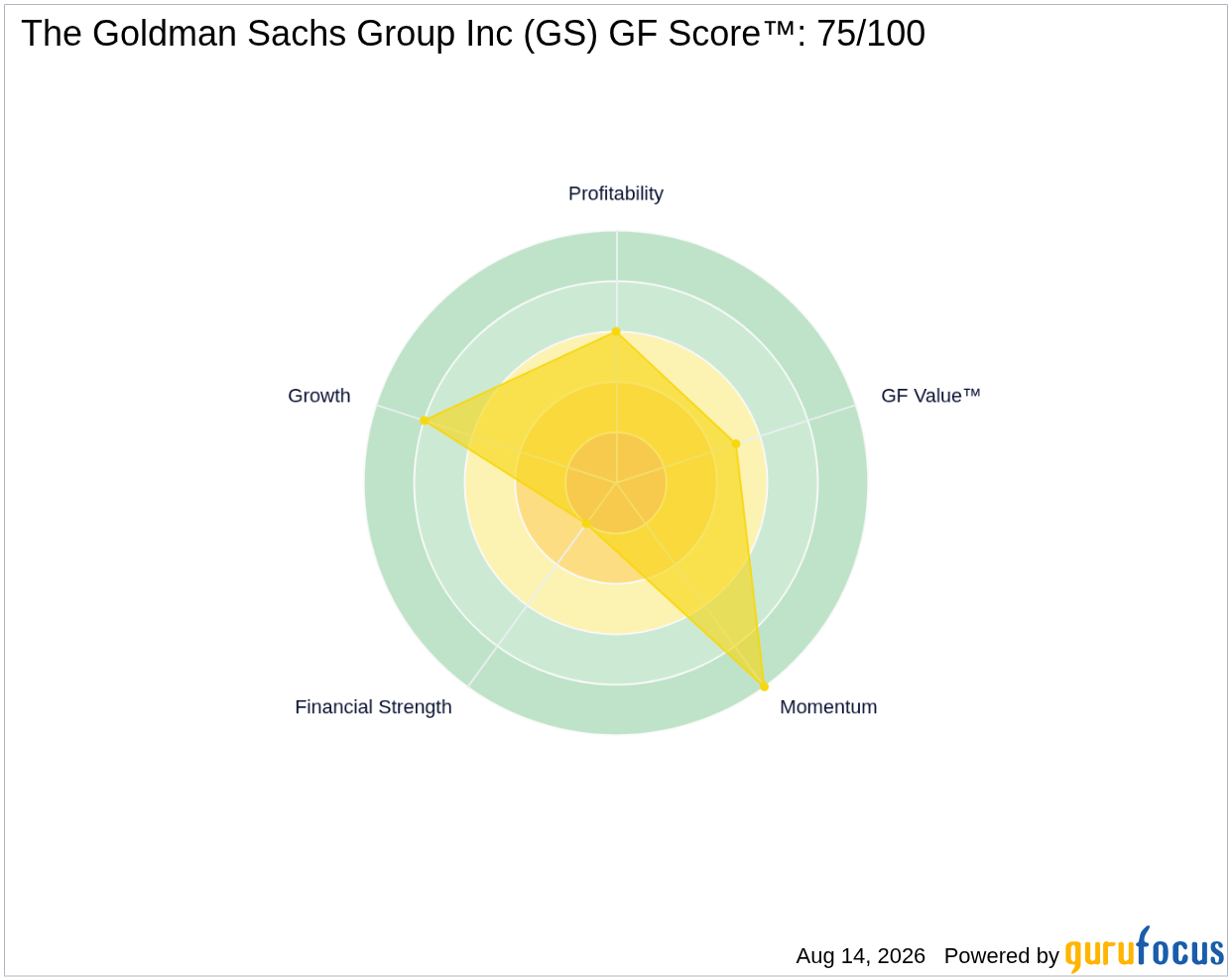
- The company holds a solid GF Score™ of 75/100, reflecting balanced strengths in growth and momentum despite financial leverage concerns.
- Insider activity shows no insider buying and $7.1 million in insider sales over the past three months, while 18 GuruFocus-tracked gurus hold GS shares, with 12 trimming and 9 adding positions recently.
What's Behind the News?
Goldman Sachs’s involvement in Nvidia’s $500 billion AI infrastructure financing initiative underscores the bank’s strategic pivot toward leveraging its asset management and private credit capabilities. By offering junior capital and facilitating debt placements with private-credit funds and public markets, Goldman Sachs aims to help establish AI infrastructure as a new, attractive asset class. Nvidia itself is prepared to back up to $125 billion of this financing, highlighting the scale and ambition of the project.
As a leading global investment bank with a market capitalization of $303.58 billion, Goldman Sachs operates primarily in the financial services sector, specifically within capital markets. Founded in 1869, the firm has diversified beyond traditional investment banking into asset and wealth management, which accounted for roughly 30% of its post-provision revenue by the end of 2025. This diversification is critical as Goldman navigates evolving market dynamics and large-scale financing opportunities like Nvidia’s AI infrastructure initiative.
Is GS Overvalued on a Price-to-Sales Basis?
Goldman Sachs’s current Price-to-Sales (P/S) ratio of 4.87x is substantially higher than its historical median of 2.61x, indicating that investors are pricing in robust future revenue growth. This premium suggests optimism about Goldman’s ability to capitalize on emerging financing trends, including the Nvidia AI infrastructure deal. However, it is important to note that GS is currently unprofitable and cash-flow negative, which renders traditional earnings-based valuation metrics such as the Price-to-Earnings (P/E) ratio less meaningful for assessing its intrinsic value.
In this context, the GF Value™ metric provides a directional warning rather than a precise valuation target. Goldman Sachs’s GF Value™ stands at $814.43, which is approximately 28.0% below the current stock price of $1,042.63, labeling the stock as modestly overvalued. This gap reflects the challenges of applying historical multiples to a company undergoing significant strategic shifts and financial restructuring. For more on GF Value™, visit GF Value™.
What Does GS's GF Score™ Tell Us?
The GF Score™ is a composite metric designed to evaluate a company’s overall quality by integrating financial strength, profitability, growth, valuation, and momentum factors. Goldman Sachs’s GF Score™ of 75 out of 100 indicates a generally favorable profile, particularly in growth and momentum, while highlighting areas of concern in financial strength.
| Metric | Rating (out of 10) |
|---|---|
| GF Score™ | 75/100 |
| Financial Strength | 2/10 |
| Profitability | 6/10 |
| Growth | 8/10 |
| Valuation | 5/10 |
| Momentum | 10/10 |
Goldman Sachs’s strongest attributes lie in its momentum and growth ranks, scoring 10 and 8 out of 10 respectively, reflecting positive investor sentiment and consistent revenue expansion. However, the financial strength rank of 2 out of 10 signals concerns about leverage and balance sheet risk, consistent with the company’s high debt-to-equity ratio of 3.56 and recent debt issuance totaling $129.6 billion over three years. Profitability and valuation ranks are moderate, indicating a mixed picture as the company balances growth initiatives with financial discipline. For further details, visit the GS stock page.
What Are Gurus and Insiders Doing with GS?
GuruFocus tracks 18 premium gurus currently holding Goldman Sachs shares. In recent quarters, 9 gurus have added to their positions while 12 have trimmed holdings, reflecting a cautious but engaged institutional investor base. This nuanced guru activity provides a unique insight into professional sentiment that is not available through platforms like Simply Wall St or Morningstar.
Insider activity over the past three months shows no insider buying and insider sales totaling $7.1 million, indicating some degree of caution from company insiders. Over the past year, insider selling has been more pronounced, with 19 transactions and no insider purchases reported. This insider selling trend may warrant attention from investors monitoring management confidence.
What This Means for Investors
Goldman Sachs’s involvement in Nvidia’s massive AI infrastructure financing initiative highlights its strategic positioning in emerging growth sectors. However, the stock’s elevated Price-to-Sales ratio and modestly overvalued GF Value™ suggest that the market is pricing in substantial future growth that is not yet reflected in earnings or cash flow. The company’s strong momentum and growth metrics are tempered by weak financial strength and insider selling, signaling potential risks related to leverage and capital structure. Investors should weigh these factors carefully, considering that traditional earnings-based valuation metrics are less applicable in GS’s current financial context. For a deeper dive into Goldman Sachs’s fundamentals and valuation, visit the GS stock page or explore investment ideas using the GuruFocus Stock Screener.
Frequently Asked Questions
What is GS's GF Score™?
GS’s GF Score™ of 75/100 reflects a balanced assessment of its financial health, profitability, growth prospects, valuation, and momentum, indicating a generally favorable but nuanced investment profile.
Is GS overvalued or undervalued?
Based on its Price-to-Sales ratio of 4.87x, which is nearly double its historical median, GS appears overvalued as the market prices in strong future growth. Earnings-based valuation like P/E is not meaningful here due to GS’s unprofitable and cash-flow-negative status.
What is GS's P/E ratio compared to historical?
GS’s trailing P/E ratio is 16.09x, slightly above its 5-year median of 14.97x. However, given the company’s current unprofitable and cash-flow-negative condition, P/E is a less reliable metric for valuation assessment.
This stock alert was generated using automated technology and GuruFocus financial data to provide readers with timely and accurate market reporting. This content was reviewed by GuruFocus editorial team prior to publication. Please send any questions or comments about this story to [email protected].

