


On August 15, 2026, Oracle Corp ORCL faced a significant setback as the Green Chile Project, a vital natural gas pipeline for its AI data center in New Mexico, was delayed by nearly six months. The new operational date is now set for February 1, 2027, complicating Oracle's Project Jupiter, a key component of its major contract with OpenAI known as Stargate. Following this announcement, Oracle's stock dropped by 5%, while Energy Transfer LP's shares rose by 1.5%. In after-hours trading, Oracle saw a slight increase of 0.21%, while Energy Transfer dipped 0.08%.
- Oracle's current Price-to-Sales (P/S) ratio is significantly higher than its historical median of approximately 5.4x, indicating that earnings-based valuation measures like P/E are not applicable, given the company's cash-flow-negative status.
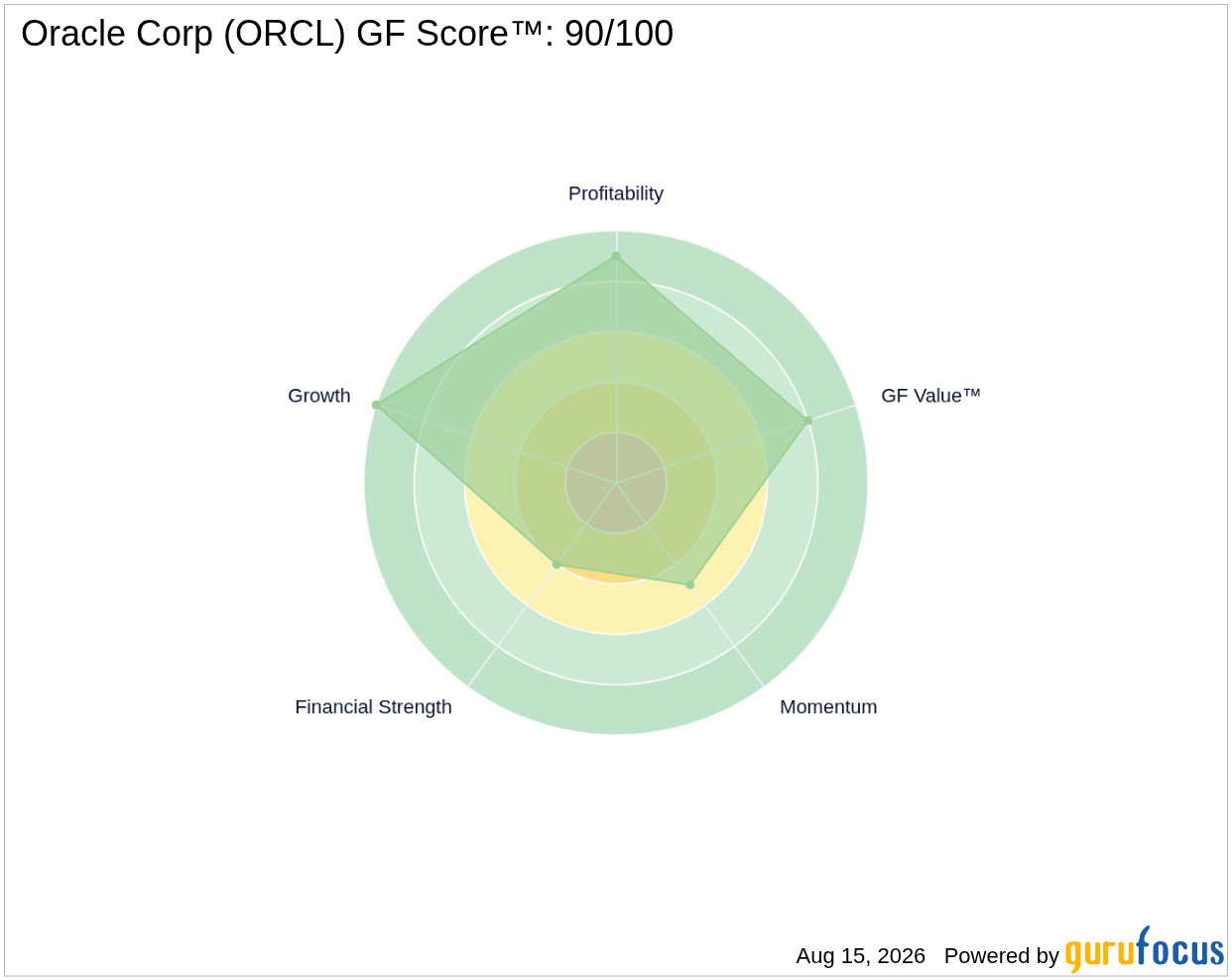
- Oracle boasts a GF Score™ of 90/100, reflecting strong fundamentals.
- Insider activity shows no insider buying over the past three months, with insiders selling shares worth $63.7 million.
What's Behind the News?
The delay in the Green Chile Project is a critical development for Oracle as it directly impacts its ambitious Project Jupiter, which is integral to its collaboration with OpenAI. The pipeline, which is expected to transport up to 400 million cubic feet of gas daily, has faced multiple rejections from the New Mexico Land Office regarding its proposed route. This setback raises concerns about the feasibility of the new operational date and could lead to further delays, complicating Oracle's plans for its AI data center that is set to utilize up to 2.5 gigawatts of gas fuel cells from Bloom Energy Corp.
Oracle Corp, founded in 1977, is a leading provider of enterprise applications and infrastructure solutions. With a market capitalization of approximately $433.57 billion, the company operates within the technology sector, specifically in the software industry. Oracle is renowned for its SQL-based relational database management systems and offers a range of IT deployment models, including cloud-based and hybrid solutions. The company's ongoing projects, particularly in AI, underscore its commitment to innovation and growth.
Is ORCL Overvalued on a Price-to-Sales Basis?
Currently, Oracle's Price-to-Sales (P/S) ratio stands at approximately 25.82x, which is significantly higher than its historical median of around 5.4x. This disparity suggests that the market is pricing in substantial future growth, which may be unrealistic given the current cash-flow-negative status of the company. Earnings-based valuation metrics, such as the P/E ratio, do not apply here due to Oracle's unprofitable status. The forward P/E ratio is 18.67x, but this figure does not provide a reliable measure of value given the company's ongoing challenges.
As a directional warning, Oracle's GF Value™ is calculated at $190.87, indicating that the stock is currently undervalued by approximately 21.1% compared to its market price of $150.52. However, investors should approach this figure cautiously, as it may not accurately reflect the intrinsic value of a company facing operational hurdles. For more details, visit GF Value™.
What Does ORCL's GF Score™ Tell Us?
The GF Score™ is a comprehensive measure that evaluates a company's financial strength, profitability, growth potential, valuation, and momentum. Oracle's GF Score™ of 90/100 indicates strong fundamentals, particularly in profitability and growth, where it ranks 9/10 and 10/10, respectively. However, its financial strength is rated lower at 4/10, reflecting potential vulnerabilities in its balance sheet.
| Metric | Rating |
|---|---|
| GF Score™ | 90 |
| Financial Strength | 4/10 |
| Profitability | 9/10 |
| Growth | 10/10 |
| Valuation | 8/10 |
| Momentum | 5/10 |
Oracle's strengths lie in its robust profitability and growth metrics, while its financial strength suggests potential risks that investors should consider. For a deeper analysis, visit the ORCL stock page.
What Are Gurus and Insiders Doing with ORCL?
Currently, 23 gurus hold Oracle shares, with 12 adding to their positions and 11 trimming their holdings in recent quarters. This indicates a generally positive sentiment among institutional investors. However, insider activity reveals a different picture, with no insider buying and a significant net sell of $63.7 million over the past three months. This divergence between guru sentiment and insider activity may raise questions about the company's near-term prospects.
What This Means for Investors
In summary, Oracle's current valuation, particularly on a Price-to-Sales basis, suggests that the stock may be overvalued given its cash-flow-negative status and the recent pipeline delays. While the GF Score™ indicates strong fundamentals, the lack of insider buying and significant sales raises concerns about the company's immediate future. Investors should carefully weigh these factors when considering their positions in Oracle. For more insights, check out the ORCL stock page.
Frequently Asked Questions
What is ORCL's GF Score™?
Oracle's GF Score™ is 90/100, indicating strong fundamentals and overall financial health.
Is ORCL overvalued or undervalued?
Oracle appears overvalued on a Price-to-Sales basis, as its P/S ratio is significantly higher than its historical median, and P/E is not meaningful for a loss-maker.
What is ORCL's P/E ratio compared to historical?
Oracle's current P/E ratio is 25.82x, compared to a 5-year median of 32.3x, indicating a decline in earnings performance.
This stock alert was generated using automated technology and GuruFocus financial data to provide readers with timely and accurate market reporting. This content was reviewed by GuruFocus editorial team prior to publication. Please send any questions or comments about this story to [email protected].

